Labor Contractions: How to Recognize Them and When to Go to the Hospital

Are you in the last weeks of pregnancy, and every time you feel something in your belly you think «is this it?» Don’t worry, it happens to everyone. Labor contractions are one of the biggest sources of uncertainty for pregnant women, and I completely understand why. As a midwife, I can tell you the number one question is always the same: «How will I know they’re real contractions?»
The problem is that nobody explains it to you calmly or with the up-to-date information you need. So you end up in a Google loop at 3 a.m., not knowing whether to rush to the hospital or go back to bed. With the right information, everything changes. Let’s look at what contractions are, how to tell the real ones apart, and when you DO need to go to the hospital 💪
What are labor contractions?
Contractions are involuntary movements of the uterus — a huge, powerful muscle that tightens and relaxes rhythmically to dilate the cervix and push your baby out. It’s your body doing exactly what it knows how to do.
When your uterus contracts, you’ll notice your belly getting hard (like a ball), you may feel pressure low in your abdomen or in your back, and it lasts a few seconds. Then it relaxes and you feel fine again. That contraction-relaxation rhythm is essential: your body works and rests, works and rests. During the rest, your baby receives fresh oxygen through the placenta, which is why your uterus can’t stay contracted all the time.
Braxton Hicks vs. labor contractions: the real difference
This is what causes the most confusion, and I want it to be crystal clear for you. I’ve seen many women arrive at the hospital with Braxton Hicks contractions thinking they were already in labor, and I’ve also had women call me saying «I think I’m having Braxton Hicks» when they were actually already 5 centimeters dilated 😅.
Braxton Hicks («practice» contractions)
- They can appear from the second trimester, although they’re more common in the third
- They’re irregular: they don’t follow a pattern. One at 10:00, another at 10:47, another at 11:30…
- They’re uncomfortable but not painful (more like tightness, not an intense pain that takes your breath away)
- They don’t get stronger over time
- They stop if you change what you’re doing: you get up, walk, take a shower, drink some water… and they go away
- They don’t dilate the cervix (or only very slightly)
- They’re more common at the end of the day, when you’ve been active, or after sex
Real labor contractions
- They’re regular: every X minutes, in a predictable way (you can time them and see a pattern)
- They gradually get stronger (they hurt more and more)
- They gradually get longer: from 20-30 seconds to 60-90 seconds
- They get closer together: from every 15 minutes to every 10, then every 5…
- They don’t stop even if you rest, change position or take a shower (in fact, movement usually makes them more productive)
- They often start in your lower back and radiate toward the front, like a wave that rises and falls
- They make you stop whatever you’re doing and focus on your breathing
The ultimate trick: if you can talk, laugh and hold a normal conversation during a contraction without any trouble, it’s probably not active labor yet. When you need to concentrate, close your eyes, breathe deeply and can’t keep up a conversation, that’s a different story.
Pregnancy and birth
MAI Method®
MAI Method®: midwife Diana Martínez's complete online preparation for pregnancy, birth and postpartum, in English. 75 video lessons plus MINDMUM® Audios, the LAI breastfeeding course and MAI Safe Baby first aid. €497, lifetime access.
See the program →The stages of labor, according to contractions
Understanding the stages will give you enormous peace of mind, because you’ll always know where you are and what to expect. I’ve seen that women who know this go through labor with much less anxiety.
Prodromal labor (pre-labor)
Contractions are irregular and can go on for hours or even days (yes, days, and that’s normal). Your body is «preparing the ground»: the cervix softens and thins (effacement), shortens and starts to open up to the first 3-4 centimeters. This stage is the longest and the most exasperating, because you feel that «something is happening» but it isn’t moving at the pace you’d like.
Prodromal contractions can come every 10-15 minutes for a few hours, then space out, then come back… It’s unpredictable. And that can be very frustrating. Many pregnant women call me saying «Diana, I’ve had contractions for two days and I’m not progressing, is that normal?» Yes, it’s completely normal.
My advice: rest as much as you can. Eat, drink, sleep, distract yourself with shows or movies. Save your energy for when you really need it. Many women reach active labor exhausted because they spent all their energy during pre-labor pacing the living room at 2 a.m. Trust that your body knows what it’s doing.
Active labor (dilation from 4-5 cm to 10 cm)
Here contractions are now regular, every 3-5 minutes, last between 45 and 90 seconds and are intense. You need concentration, breathing techniques and pain management. This is the time to be at the hospital, or with your birth team at home.
In this stage, the cervix dilates roughly 1 centimeter per hour (it can be slower for first-time mothers and faster for women who have given birth before). The contractions are productive: each one is doing something real, making way for your baby.
Transition (from 8 cm to 10 cm)
This is the most intense stage but also the shortest (it usually lasts between 15 minutes and 1 hour). Contractions come very close together (every 2-3 minutes), they’re very intense, and you may feel nauseous, shaky, or suddenly cold or hot. This is completely normal. Your body is in full labor. Many women in this stage say «I can’t do this anymore,» but that’s precisely when you’re closest to meeting your baby.
Pushing stage
Contractions are very intense but may space out a little (every 3-4 minutes). You feel enormous pressure in your rectum, like an irresistible urge to poop (but it’s your baby moving down the birth canal). Your body is telling you to push. In this stage, contractions change character: they no longer just dilate, they push. And you can work with them, or simply let yourself go if your body pushes spontaneously.
When to go to the hospital? The practical rule (and its exceptions)
Many women ask me this with a worried look on their face: «What if I go too early and they send me home? What if I leave it too late and give birth in the car?» Don’t worry. There’s a rule that works very well as a guide:
The 4-1-1 (or 5-1-1) rule:
- Contractions every 4-5 minutes
- Lasting at least 1 minute
- For at least 1 hour in a row
When all three criteria are met consistently, it’s time to go to the hospital. But be careful: this rule has some very important exceptions you need to know about:
Go to the hospital IMMEDIATELY if:
- Your water breaks: especially if the fluid is greenish, brown (meconium) or foul-smelling, or if your baby isn’t engaged yet. If the fluid is clear, you can wait for regular contractions to start, but check with your midwife/hospital.
- Heavy vaginal bleeding: not the mucus plug with streaks of blood (which is normal), but red blood like a heavy period or more. This can indicate a problem with the placenta.
- You can’t feel your baby moving compared with what’s usual for you. If you haven’t felt your baby for more than 2 hours and they still don’t move after you drink something cold and lie on your side, go without waiting.
- A very severe headache, blurred vision, seeing flashing lights or spots, pain in the upper stomach (just below the breastbone), or sudden swelling of your face/hands/feet: these can be signs of preeclampsia, a serious complication that needs urgent care.
- It’s your second or third birth: later labors are usually faster. Don’t wait for the 4-1-1 rule if you feel things are moving quickly. Many women who have given birth before deliver in less than 3 hours from the start of regular contractions.
- Severe, continuous abdominal pain (that doesn’t ease between contractions): this can indicate placental abruption or another complication.
If you’re unsure, call the hospital or your midwife. It’s better to ask 10 times than to stay at home with a doubt that’s making you anxious. Nobody is going to judge you for calling; that’s what we’re here for.
How to cope with contractions: techniques that really work
I know you’re often told that the epidural is the only way to cope with labor contractions. But although it’s a fantastic option you can choose if you want to, that isn’t true. There are many other options that not only relieve pain but also help make your labor faster and easier. And they’re compatible with an epidural. Ideally, you can make informed decisions 🥰
Non-drug techniques (my personal list of what DOES work)
From my experience, I can tell you these techniques make a real difference:
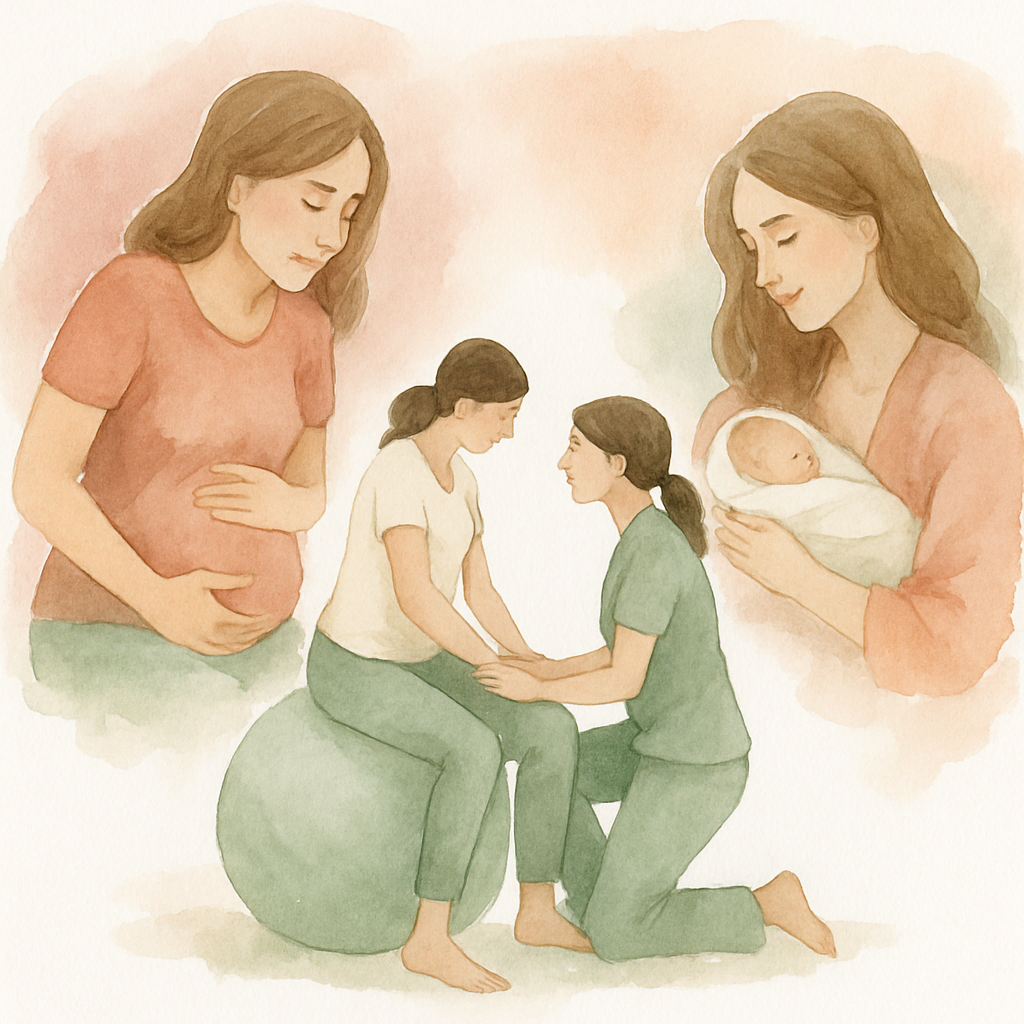
- Movement and changing positions: walking, squatting, rocking on a birth ball, going up and down stairs (yes, really). Gravity is your ally, and movement helps your baby settle better into your pelvis.
- Warm water: a shower on your lower back during contractions, or a bath, is natural pain relief. Warm water relaxes your muscles and reduces how much pain you feel. It’s like a natural epidural (obviously not at the same level, but it helps a lot).
- Conscious breathing: not the typical movie breathing («hee hee hoo hoo»), but slow, deep breaths. Breathe in through your nose and out through your mouth as if you were blowing out a candle. This activates your parasympathetic nervous system and lowers adrenaline.
- Massage and counterpressure on the sacrum: have your partner or birth companion press firmly (really, FIRMLY) on your lower back during the contraction with their fists or palms. It works wonders for back pain.
- TENS (electrical nerve stimulation): a device you place on your lower back. Very effective in the early stages of labor. You can rent or buy one. More info in my article on TENS for labor.
- Vocalizing: making low sounds (not high-pitched, like screams) during the contraction. Sounds like «ooooh,» «aaaah.» This helps relax your pelvic floor and release tension in your jaw (which is neurologically connected to your pelvis).
- Darkness, quiet and privacy: your mammal brain needs to feel safe to release oxytocin. Dim lights, few people in the room, silence or soft music. If there’s bright white light, people talking and stress, your body releases adrenaline and labor slows down.
What about the epidural?
It’s a mistake to say an epidural can only be given up to 5, 6 or 7 centimeters. Because it isn’t true. An epidural can be given at any point during dilation if the clinical situation allows it and an anesthesiologist is available. I’ve had epidurals placed at 9 centimeters and they’ve worked perfectly.
Ideally, you can make informed decisions, without rushing and without pressure. If you decide to have one from the start, great. If you’d rather try without it and then change your mind, also great. What matters is that it’s YOUR decision, not anyone else’s. And that nobody makes you feel guilty for the option you choose.
Your birth partner’s role during contractions
Your partner or trusted person has a key role. They’re not there as decoration or just to «cut the cord and take the photo.» They can be your real support if they know what to do:
- Apply counterpressure to your sacrum during contractions
- Remind you to breathe when you freeze up or tense
- Bring you water, put cool cloths on your forehead, fan you
- Talk to the medical team when you can’t or don’t want to
- Stand up for your birth plan if needed
- Simply be there, quietly, holding your hand and helping you feel calm
What if contractions stop in the middle of labor?
Yes, it can happen. You’re having regular contractions, maybe you’re even already at the hospital, and suddenly… they stop. Is that normal? Yes, it’s more common than you think. It can happen because of:
- Stress or fear: you got to the hospital, they put you on a bed under white light, 5 people came in to ask you questions… your adrenaline shoots up and your oxytocin slows down.
- A change of environment: leaving home, the car ride, arriving at the hospital. Your mammal brain gets scared and says «this isn’t safe, let’s wait.»
- Extreme tiredness: if you’ve had days of pre-labor without sleep, your body may ask for a break.
- Your baby’s position: sometimes the baby is in a position that makes it harder to engage, and contractions slow down until they change position.
If it happens: don’t panic. Rest, eat something light, try to sleep (yes, believe it or not, some women sleep between widely spaced contractions). If your body is ready, the contractions will come back. And if they don’t come back within a reasonable time (24-48 hours after your waters break), your medical team will assess the next steps: stimulation with synthetic oxytocin, waiting longer if mother and baby are well, etc.
Prepare with information: the power of knowledge
Having information doesn’t always take the fear away. Most women don’t need more technical facts; they need to feel supported and empowered. But good preparation gives you tools to handle whatever comes, and that is power.
I recommend having a written birth plan that sets out your preferences. It’s not a contract; it’s a guide so your team knows what you want. And the more informed you are, the better you’ll know what to ask for and why.
If you’re looking for complete, up-to-date, evidence-based birth preparation, I invite you to discover the MAI Method®. It’s the program I designed, with all the information you need to go into labor without fear, with confidence and with real tools 🥰.
Frequently asked questions about labor contractions
How do I know if they’re labor contractions or Braxton Hicks?
Labor contractions are regular, increase in intensity, length and frequency over time, and don’t stop even if you change what you’re doing. Braxton Hicks are irregular, don’t get stronger, and usually stop if you rest, drink water or change position. If you can time them and see a clear pattern every X minutes for at least 1 hour, they’re probably labor contractions.
Do labor contractions always hurt?
Labor contractions are intense, but how pain is perceived is very personal. Some women describe them as very strong period pain, others as enormous pressure, others as back pain that comes in waves. What is true is that as labor progresses, contractions become more intense. But remember: the pain has a purpose (to dilate and push your baby out) and it comes in waves; it isn’t constant.
Can I have a labor without painful contractions?
Contractions are the engine of labor, so you can’t have a labor without them. But you can have a labor in which contractions are manageable with non-drug techniques, or with an epidural to reduce or eliminate the pain. There are labors in which the woman is so relaxed, in such a safe environment and with so much oxytocin flowing, that the contractions aren’t felt as «pain» but as «intense pressure.» But this isn’t the most common experience.
How long do labor contractions last?
Each individual contraction lasts between 30 and 90 seconds, depending on which stage of labor you’re in. At the beginning (pre-labor and early active labor) they last about 30-45 seconds. As labor progresses, they can last 60-90 seconds. The important thing is that there’s rest between contractions: your uterus relaxes completely and you can breathe, drink water, talk and rest.
What if I get to the hospital and they tell me I’m not in labor yet?
It’s very normal to be sent home if you arrive less than 3-4 centimeters dilated and with contractions that are still irregular. It’s not a failure; it’s part of the process. Many first-time mothers go home 1 or 2 times before being admitted. My advice: use the time to rest in your own space, where you’re more comfortable. Your labor will happen; there’s no rush.
Do contractions always start before your water breaks?
No. In most cases (80-90%), contractions start first and the bag of waters breaks during labor. But in some cases (10-20%), the bag of waters breaks first and then contractions start. If this happens to you, contractions usually begin within the next few hours. If they don’t start within 12-24 hours, your medical team will consider inducing labor to reduce the risk of infection.
Can I speed up contractions if they’re very slow?
There are things that can help stimulate contractions naturally: walking, going up and down stairs, nipple stimulation, sex (if your water hasn’t broken yet), acupuncture. But be aware: if your body isn’t ready, none of this will trigger labor. Don’t force things. Your baby will arrive when they’re ready. Trust the process.
If you want to go into labor with all the information you need, practical tools and the support of a midwife, I invite you to discover the MAI Method®. It’s the most complete preparation I’ve designed so you can go into labor informed, empowered and without fear 🥰.
Your next step
MAI Method® · €497
MAI Method®: midwife Diana Martínez's complete online preparation for pregnancy, birth and postpartum, in English. 75 video lessons plus MINDMUM® Audios, the LAI breastfeeding course and MAI Safe Baby first aid. €497, lifetime access.
I want MAI Method® →This article informs and supports you; it does not replace the care of the professionals looking after you in your pregnancy, birth and postpartum.