Perineal Massage in Pregnancy: How to Do It Step by Step (A Midwife’s Guide)
Many women ask me whether perineal massage during pregnancy is really worth it. And my answer is always the same: yes, absolutely yes. As a midwife, I’ve supported thousands of births, and I can tell you that women who practice it have fewer tears and fewer episiotomies. It’s not magic — it’s scientific evidence.
The perineum is the group of muscles that surrounds the vagina and the anus. During birth, this area has to stretch a great deal so your baby can be born. Perineal massage prepares these tissues to be more elastic and flexible, reducing the risk of them tearing in a traumatic way.
Why does perineal massage work? Science backs it up
The studies are pretty clear on this. A Cochrane review — the most rigorous kind of review in medicine — showed that perineal massage done from week 35 onward significantly reduces the risk of third- and fourth-degree tears and the need for an episiotomy, especially in women giving birth for the first time.
But what I value most, after seeing so many births, is that massage also helps you get to know your body. Many women reach labor without ever having touched that part of their body with the intention of caring for it. Massage breaks that taboo and connects you with what’s going to happen.
When to start and how often?
Ideally, start from week 34-36 of pregnancy. Before that it doesn’t make much sense, because the tissue isn’t hormonally ready to respond well to stretching.
The recommended frequency is 3-4 times a week, although if you can do it every day, even better. 5-10 minutes per session is enough. It’s not about quantity; it’s about consistency.
Who can do it?
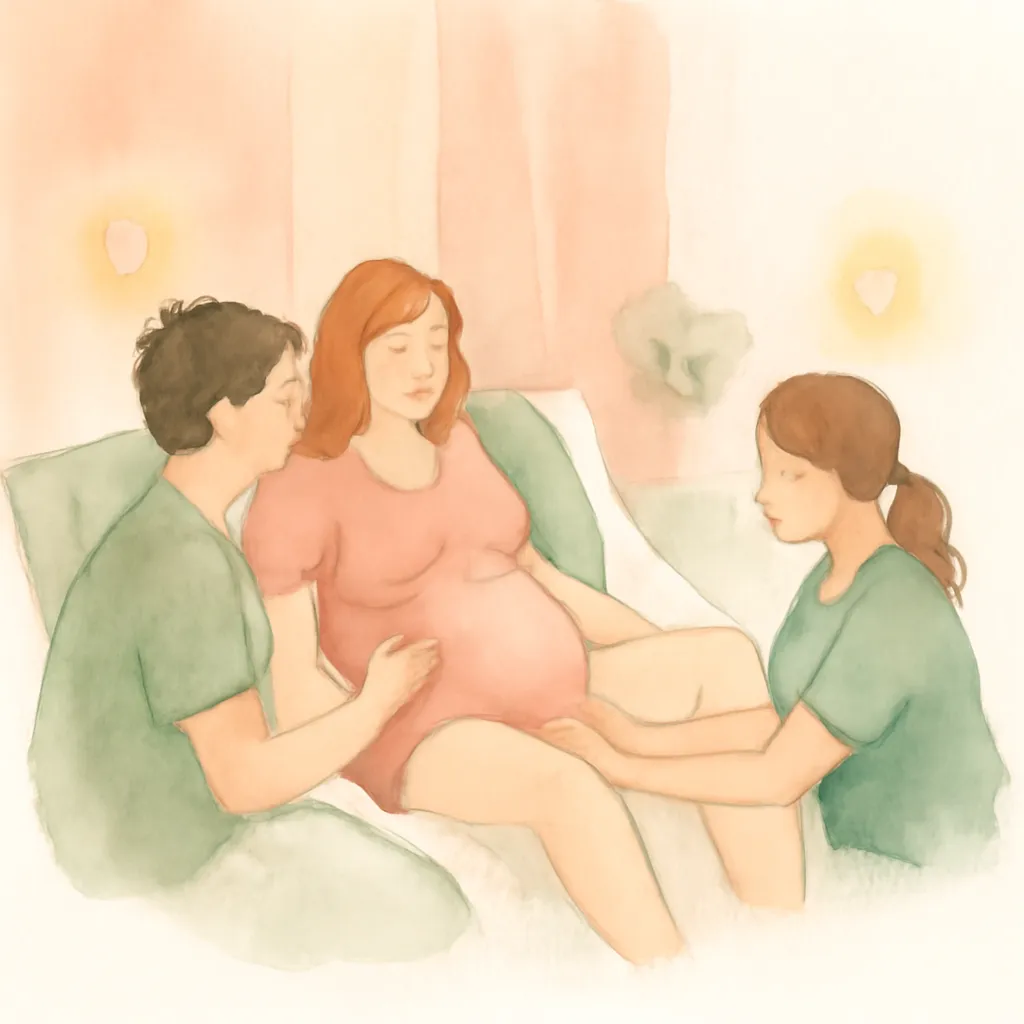
You can do it yourself or ask your partner to help. Many women prefer their partner to do it because, with a late-pregnancy bump, it’s hard to reach. Both options are equally valid.
Pregnancy and birth
MAI Method®
MAI Method®: midwife Diana Martínez's complete online preparation for pregnancy, birth and postpartum, in English. 75 video lessons plus MINDMUM® Audios, the LAI breastfeeding course and MAI Safe Baby first aid. €497, lifetime access.
See the program →What you need for perineal massage
- Massage oil: Sweet almond oil or extra virgin olive oil work really well. You can also use a perineal massage oil (some brands make them specifically for this). Avoid undiluted essential oils and scented creams — they can irritate the delicate mucous membrane.
- Short nails and clean hands: This is essential. No long nails in that area.
- A comfortable position: Semi-reclined with a pillow behind your back, or standing with one foot up on the edge of the bathtub or on a chair.
- Privacy and calm: Don’t rush it. Create a calm moment just for you.
How to do perineal massage step by step
I’m going to explain the technique clearly and directly, because it’s important to do it properly for it to work:
Step 1: Preparation
Empty your bladder before you start. Wash your hands with soap and water and make sure your nails are short. Put a little oil on your thumbs (if you’re doing it yourself) or on the index and middle fingers (if your partner is doing it).
Step 2: Position
Get into a semi-reclined position, with your knees bent and your feet flat. If you can, put a pillow under your hips so the area is easier to reach. Breathe slowly and relax.
Step 3: The technique
Insert your thumbs (or your partner’s fingers) into the vagina, about 3-4 centimeters deep. Then:
- Press gently downward (toward the anus) until you feel a slight tingling or stretching. It shouldn’t hurt — if it does, ease off the pressure.
- Hold that pressure for 1-2 minutes, breathing deeply and letting the tissues relax.
- Next, make «U»-shaped or semicircular movements, sliding your fingers from one side of the lower vaginal opening to the other, always keeping that downward pressure.
- Repeat the movement for 5-10 minutes in total.
Step 4: The outside
You can also massage the outside of the perineum — the skin between the vagina and the anus — with gentle circular movements using the oil. This softens that specific area, which is usually the one most prone to tearing.
Normal sensations (and when to stop)
It’s completely normal to feel the following at first:
- Tension or pressure in the area
- Mild burning or tingling
- Discomfort (especially the first few times)
Over the weeks, these sensations will gradually ease as the tissue becomes more elastic. That’s exactly what we’re aiming for.
Stop the massage and check with your midwife if:
- You feel severe pain
- There is bleeding
- You have an active vaginal infection
- You have placenta previa
- Your pregnancy has a complication that requires pelvic rest
What if it’s my first baby, or I’ve already had children?
The evidence shows that perineal massage is especially helpful for first-time mothers (women giving birth for the first time), who have a higher risk of tearing. In women who have given birth before, the tissues usually have more «elastic memory,» but massage is still beneficial.
Did you know that in women who already have a scar from a previous episiotomy, massage is especially helpful for softening that scar tissue? It’s one of its lesser-known benefits.
Combining perineal massage with other preparation
Perineal massage works best when you combine it with:
- Kegel exercises: They strengthen your pelvic floor and give you more control during the pushing stage.
- Breathing techniques: Learning how to breathe while pushing so your perineum relaxes instead of tensing.
- Childbirth education: Learning about the different birth positions that help protect the perineum.
In my birth preparation classes, I always spend time teaching both the massage technique and breathing strategies for the pushing stage. Because the perineum is an area that deserves all our attention and care.
The reality of the perineum in labor: what nobody tells you
From my experience attending births, I want to bust a myth: tearing isn’t always avoidable, and it isn’t always something terrible. A small tear (first- or second-degree) that happens naturally usually heals better and with fewer after-effects than even a well-performed episiotomy.
What we want to avoid are third- and fourth-degree tears (the ones that reach the anal sphincter), which can have more serious consequences. And that’s where perineal massage makes a difference.
It’s also important for you to know that a good position during the pushing stage, a midwife who knows how to protect the perineum with her hands, and controlled pushing do as much (or more) than weeks of massage. Massage is a tool, not a guarantee.
Frequently asked questions about perineal massage
Is it normal not to be able to relax at first?
Totally. Many women have a lot of reflex tension in that area at first. With practice, you’ll learn to recognize that tension and consciously let it go. That learning is in itself very valuable for when you give birth.
Can I do it during my period or if I have discharge?
There are no periods during pregnancy, so that’s not an issue. If you have more discharge than usual or notice that it smells different, check with your midwife before continuing with the massage — it could be a sign of an infection that should be treated first.
Can my baby feel it?
No, your baby doesn’t feel the massage. They’re protected inside the uterus, and the massage only affects the outer tissues. You can do it with complete peace of mind.
Which oil is best: almond, olive or something else?
All three work well. Sweet almond oil is the most commonly recommended because it’s very gentle and glides nicely. Olive oil also works really well — in fact, many of us midwives recommend it because you already have it at home and it’s completely natural. Avoid mineral oils (like petroleum jelly) and products with artificial fragrances.
💕 Enjoyed this? Join our community of mindful moms
Exclusive content on pregnancy, birth and motherhood every week 🤰
Your next step
MAI Method® · €497
MAI Method®: midwife Diana Martínez's complete online preparation for pregnancy, birth and postpartum, in English. 75 video lessons plus MINDMUM® Audios, the LAI breastfeeding course and MAI Safe Baby first aid. €497, lifetime access.
I want MAI Method® →This article informs and supports you; it does not replace the care of the professionals looking after you in your pregnancy, birth and postpartum.